Pilgrim’s Journal

KO EN

Open the app

The Pilgrim’s Heart · About

Where journaling becomes prayer

Today, much of journaling stops at recording the day’s events and feelings. Yet the devout Christians of history used the journal not as a mere logbook but as a means of walking with God — a place of earnest, searching spiritual reflection.

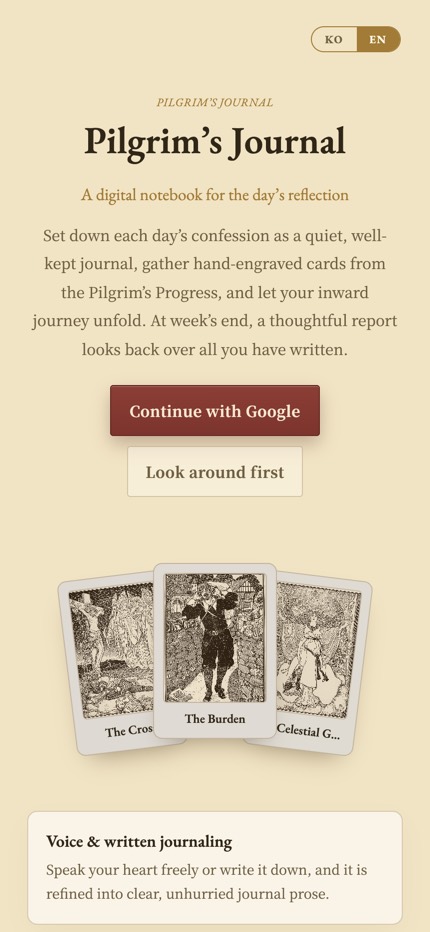
The opening screen of Pilgrim's Journal, with the app name, a short introduction, the sign-in buttons, and three Pilgrim's Progress engraving cards fanned out below.

The method · W.A.Y.S.Screens in progress

The day before the Word, in four steps

Stand ye in the ways, and see, and ask for the old paths, where is the good way, and walk therein, and ye shall find rest for your souls.

Jeremiah 6:16, Authorized (King James) Version

W.A.Y.S. means a road. The old paths of the Puritan inheritance, the walking of a pilgrimage, and the Pilgrim’s Progress itself gather into one word. It is not four letters forced into an acronym but the app’s own identity, written out.

W God speaks  →  A and asks one thing of me  →  Y before which my true state is uncovered  →  S and so I pray

W

Word · what you received

Write down what God said to you today. Whether it came through the M’Cheyne reading, the Sunday sermon, or the book in your hands, the channel does not matter. One verse that stayed with you and one line of what it says are enough. This is a place for receiving, not for exposition.
A

Application · what He asks

Write the one thing that word asks of you today. The subject of the sentence is God, not you — “He asks this,” not “I will do this.” That is precisely where this parts ways with a self-improvement resolution list. Write three things and you will do none of them.

Y

Yearning · your true state, and longing

First the mercies received today; then the state uncovered in you by what He asks. The destination is always a longing for Christ. The order is fixed on purpose, so that self-examination never hardens into self-condemnation.

S

Supplication · for yourself and others

Pray for yourself, then for your neighbour, then for the church and the world. What was uncovered in Y becomes the prayer itself, which is why S comes last. The list of those you carry is not rewritten each day; it stays with you.

One box is enough. An empty box is also part of today.

You are never asked to fill all four. One entry completes the day. Empty boxes carry no red marks or warnings, and there are no streaks and no completion rates. The four questions simply stand ready, so that a day with nothing to say does not end at a blank page.

The daily entry

Today’s page, and a guide from Brainerd’s diary

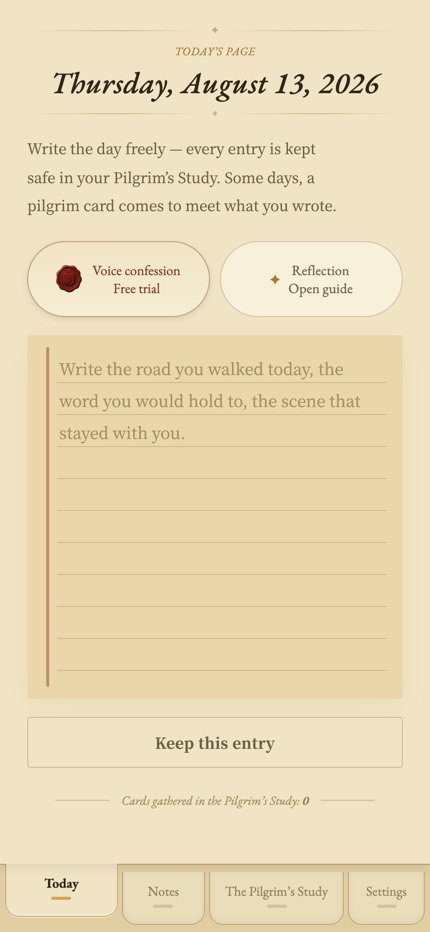
You may quietly record your day by typing, or — speaking aloud as if in conversation with God — let the app gather your unordered confession into clean sentences and keep it as a journal of the soul.

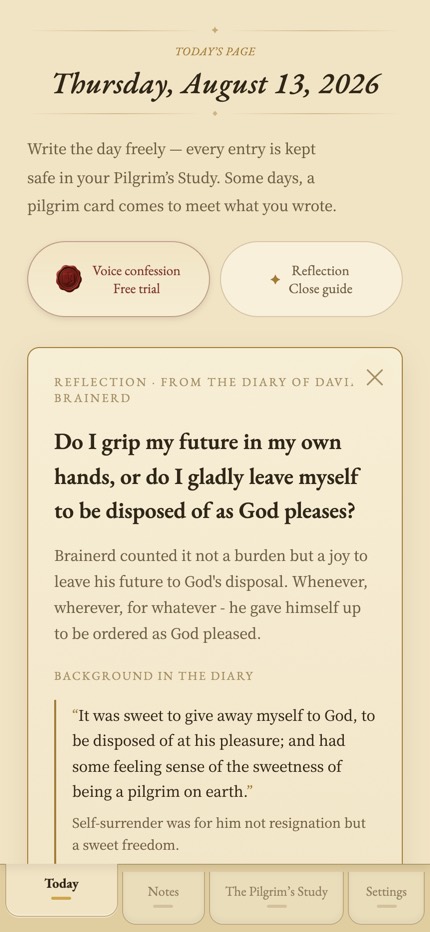
Before you write, open the “Reflection Guide,” and a question drawn from David Brainerd’s diary, edited by Jonathan Edwards, comes to you, one each day. Each carries a source footnote showing the spiritual struggle in which he first asked it of himself — so that, following its lead, you face today honestly before the Lord.

The Today's Page screen, with the date, a voice confession button, a reflection guide button, and a ruled journal page.
Today’s page
The reflection guide screen, showing a question drawn from Brainerd's diary with commentary and a source footnote.
The reflection guide

Handwritten journalIn progress

Your own hand, kept — and still searchable

Something is lost the moment writing is typed: the pressure of the nib, the place where you hesitated, the line where your hand shook. So we are building a journal you write by hand, with a tablet and stylus.

What is kept is not a flat image but vector strokes, carrying the path and pressure of the pen, so a page can be reopened, continued, and corrected later. On-device text recognition is added on top, so handwriting can be searched as well — and you confirm and correct what was recognised.

The card archive

73 engravings, gathered in the Pilgrim’s Study

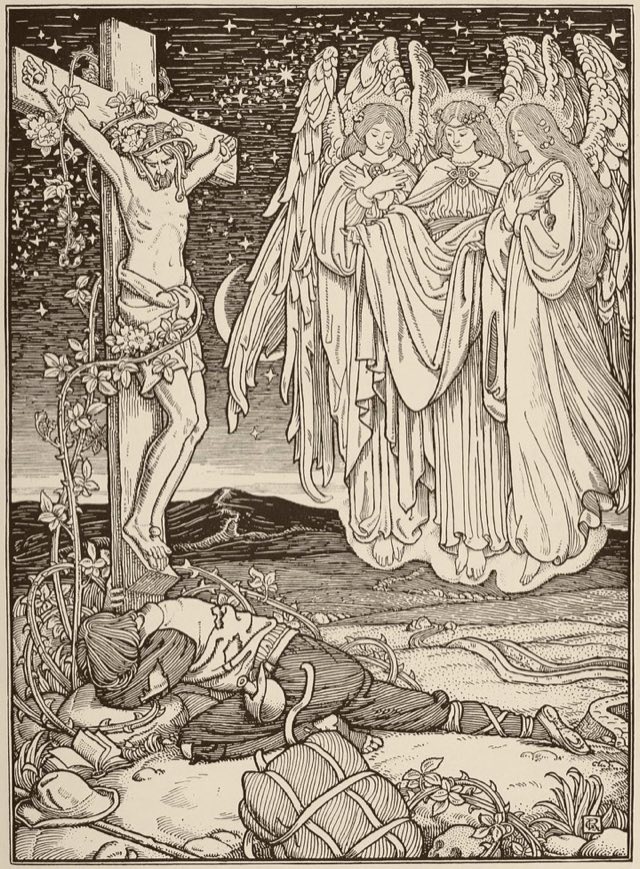
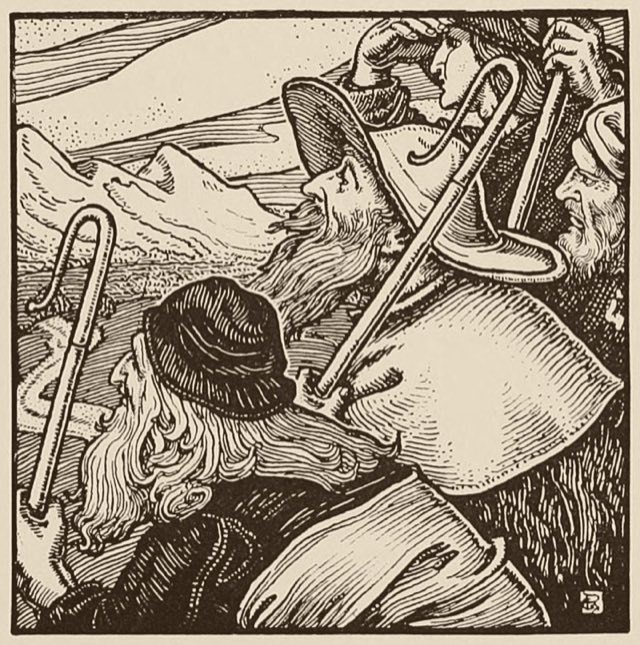
The Pilgrim’s Progress, picturing the strenuous journey from the dawn of salvation to the Celestial City, is an intuitive landmark of our faith. The app reads the day’s reflection you have written and connects it to the engraving nearest your present spiritual state.

Printed as if upon aged parchment, these classic engraving cards are archived, one by one, in “The Pilgrim’s Study,” so you may look back on the traces of grace and your growth at any time. Each card carries, on its back, a word of application drawn from that scene.

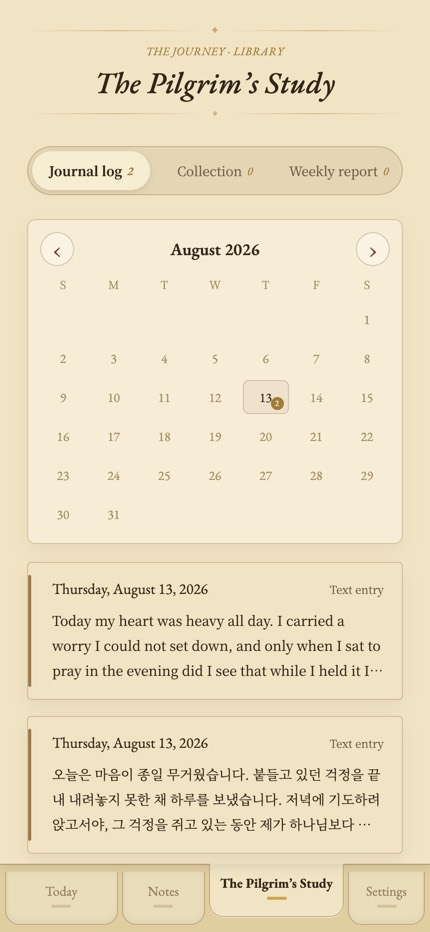
The Pilgrim's Study screen, with tabs for the journal, the card collection and weekly reports, a calendar, and the day's entry.
The Pilgrim’s Study

The weekly report

A week, gathered into a single page

Your week’s entries are gathered into a report tracing your spiritual path and its prayers, with one card standing for the whole week, rendered as a coloured engraving. Nothing is scored and nothing is graded; the road you have walked is simply shown back to you.

Boundaries

What the AI does not do

Here the AI is an assistant, never a counsellor. It seems right to tell you first what it has been forbidden to do.

  • It does not write your meditation. Nor does it expound the text.
  • It does not suggest applications. Instead it quietly shows you what you yourself wrote before.
  • It does not diagnose your spiritual state or analyse your feelings. Judging the state of a heart is not the AI’s place.
  • It does not compose prayers for you. It only brings back the names you have been carrying.
  • It does not send your entries outward. No email, notification, or log carries your text or a close summary of it.

Where you can use it

On the web today, in the hand soon

  • Available now

    Web app

    Open it in a browser, or add it to your home screen and it opens like an app. You may also look around first without signing in.

  • Preparing for release

    Android

    The handwritten journal grows here, built for tablets and a stylus, together with text recognition that runs on the device itself.

  • Planned

    iOS

    To follow, once the web app and Android have settled.

Roots

John Bunyan and David Brainerd

This app was born from the spiritual inheritance of two of the deepest souls in Christian history — John Bunyan and David Brainerd. Their devout tradition is woven, in full, into features for today’s believer.

I will meditate in thy precepts, and have respect unto thy ways.

Psalm 119:15, Authorized (King James) Version

Amid busy days it is no easy thing to take up the pen each night and refine the soul’s confession into words. So this app has lowered the threshold of the tradition with technology — lowered it only, without moving it or standing in its place.

That journaling may become prayer, remembrance become thanksgiving, and the ordinary day become worship — we hope to be the most modern and yet the most classic of spiritual companions.

Open the app See pricing